AI is moving from answering questions to taking action. Agents can use tools, access enterprise data, and carry out work across systems on our behalf or autonomously. This creates opportunities for businesses to move faster, but it also changes what security must protect. An agent’s identity, the authority it carries, and the actions it takes all become security decisions.
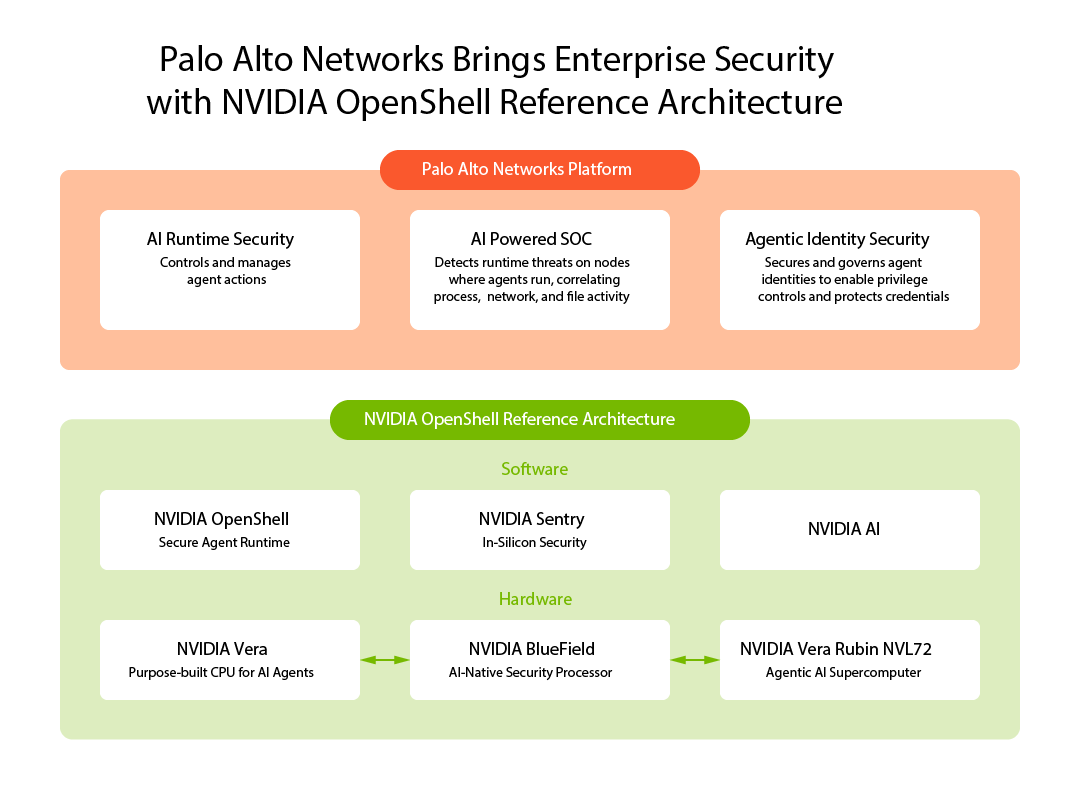
As enterprises put agents into production, they need controls that keep pace without hindering the work those agents are designed to do. Palo Alto Networks is working with NVIDIA to advance this goal across five connected areas in support of the NVIDIA OpenShell Reference Architecture for safe AI agents: an AI gateway on NVIDIA Vera CPU systems; runtime protection on NVIDIA BlueField DPUs; agent identity governance on NVIDIA Sentry; AI factory visibility through an AI-driven, agentic security operations center (SOC); and partner services that help customers implement a secure architecture.
Palo Alto Networks AI Runtime Security Extends Protection Across the AI Factory and Edge
Until now, the AI factory conversation has centered primarily on compute capacity and token generation. But as autonomous agents execute higher-stakes workloads, runtime security has become just as essential. Agents can be steered past their guardrails, and a compromised host cannot be trusted to accurately report what occurred. To be effective, security teams require visibility and enforcement that operate independently of the host environment.
Palo Alto Networks AI Runtime Security on NVIDIA BlueField DPUs isolates security processing in a dedicated infrastructure domain. Because BlueField sits in the path between agents and the models, data, and services they access, security policies are enforced in silicon — beyond the reach of a compromised host. This capability safeguards both GPU-accelerated AI workloads and CPU-based agent runtimes and is now generally available across AI factory and industrial edge deployments. Offloading security from the host node delivers two critical benefits: increased token throughput and stronger runtime protection across the entire AI factory.
Deployment at scale must be manageable. Our work with Spectro Cloud manages the deployment and operation of AI Runtime Security on BlueField DPUs, enabling consistent management across the AI factory infrastructure — from the data center to distributed edge environments.
Idira Governs the Identity Behind Every Agent Action
Runtime protection answers what an agent is doing. Identity governance helps determine whether it is authorized to do it.
An agent may act for a person, a team, or an autonomous business process, often requiring access to multiple tools and data sources across the organization. Granting an agent broad, persistent access creates risk, while making access too restrictive limits its usefulness. To achieve the optimal balance of control and agent access, Palo Alto Networks is advancing an integration between agentic identity security and NVIDIA Sentry on BlueField — bringing identity and delegated authority closer to where agent interactions are governed.
The goal is to give each agent a verifiable identity, grant access appropriate to its task, and make its actions attributable. Once available, this solution will deliver zero-trust protection and tamper-resistant auditing for agents by moving the security controls — including identity — to the NVIDIA Bluefield DPU, separate from the host operating system. This addresses an immediate business need — enabling enterprises to scale agent deployments while retaining control over whose authority agents use and which resources they can reach.
Bringing AI Factory Signals into Cortex
Security teams need visibility into activity across the infrastructure that runs AI agents. Palo Alto Networks has announced an integration of Cortex XSIAM with NVIDIA DOCA Argus, which monitors host activity from BlueField’s independent trust domain. This provides security operations teams with runtime signals that do not rely on an agent installed on the host being monitored.
By bringing those signals together with network, cloud, and identity data in an AI-driven SOC, security teams can investigate AI infrastructure in the context of the broader enterprise. Palo Alto Networks is continuing to develop this foundation to support broader fleet visibility and more comprehensive response workflows — enabling security teams to identify unusual activity and act with greater confidence as AI deployments grow.
AI agents run within the NVIDIA OpenShell secure runtime, operated directly on the NVIDIA Vera CPU within the NVIDIA OpenShell Platform. Security observability is completely offloaded to the NVIDIA BlueField DPU. Operating out-of-band, NVIDIA Sentry, built on DOCA Argus, provides real-time memory and network inspection to detect threats without slowing AI inference. When malicious events or policy violations occur, DOCA Argus streams high-fidelity alerts directly to Palo Alto Networks Cortex XSIAM, where they can be automatically correlated and surfaced for rapid threat response.
Turning Secure AI Factory Designs into Deployments
Customers need more than an architecture diagram to bring an AI factory into production. They need a practical path to design, validate, and operate security across compute, networking, applications, and the SOC.
Palo Alto Networks is working with strategic vendors , including Deloitte and World Wide Technology (WWT), to help customers plan and deploy secure NVIDIA AI factories. Deloitte’s Silicon-to-Service (S2S) offering, combined with its Secure AI Foundations, helps organizations implement AI use cases on NVIDIA AI infrastructure through validated architectures and managed services. By building security into the full AI factory stack, Deloitte helps clients balance performance, safety, and cost as they scale from pilot to production.
WWT’s AI Proving Ground allows customers to evaluate and test an integrated stack before committing to production deployment.These engagements can help enterprises move from individual security components to a repeatable approach tailored to their environments and requirements.
Building Confidence into the Next Phase of Agentic AI
The value of agentic AI depends on an enterprise’s ability to give agents useful access while maintaining control over their actions. This requires runtime protection, governed identities, independent visibility, and a unified way to manage controls across the enterprise.
Palo Alto Networks delivers comprehensive security across every layer of the AI factory through a unified platform. In collaboration with NVIDIA, we support the NVIDIA OpenShell Reference Architecture for enterprise governance, isolation, and security. Together, we deliver the continuous protection needed to move safely from AI agent pilots to full-scale enterprise production.
To learn more about the general availability of AI Runtime Security on the BlueField DPU, read our blog, Palo Alto Networks Announces Support for NVIDIA Enterprise AI Factory.