AI agents are transforming how organizations develop and deploy software. From writing code and configuring pipelines to deploying applications and testing security, autonomous agents are taking on greater responsibility across cloud environments.
While AI is accelerating development, security teams are struggling to keep pace. Traditional security controls, fragmented visibility, and manual response processes were not designed for environments where autonomous agents can make changes at machine speed.
At the same time, advances in frontier AI are introducing new security challenges. Adversaries are gaining the ability to discover vulnerabilities, develop exploits, and execute increasingly sophisticated attacks faster than ever before.
Today, we're releasing our sixth annual State of Cloud Security Report, based on a survey of 2,800 security leaders and practitioners across 10 countries and 13 industries.
The research reveals a growing disconnect between the speed of AI-driven development, the increasing sophistication of cyberattacks, and organizations' ability to prevent, detect, and respond to security risks.
Here are three key findings from this year's report.
1. AI Agents Are Accelerating Development Faster Than Security Can Keep Up
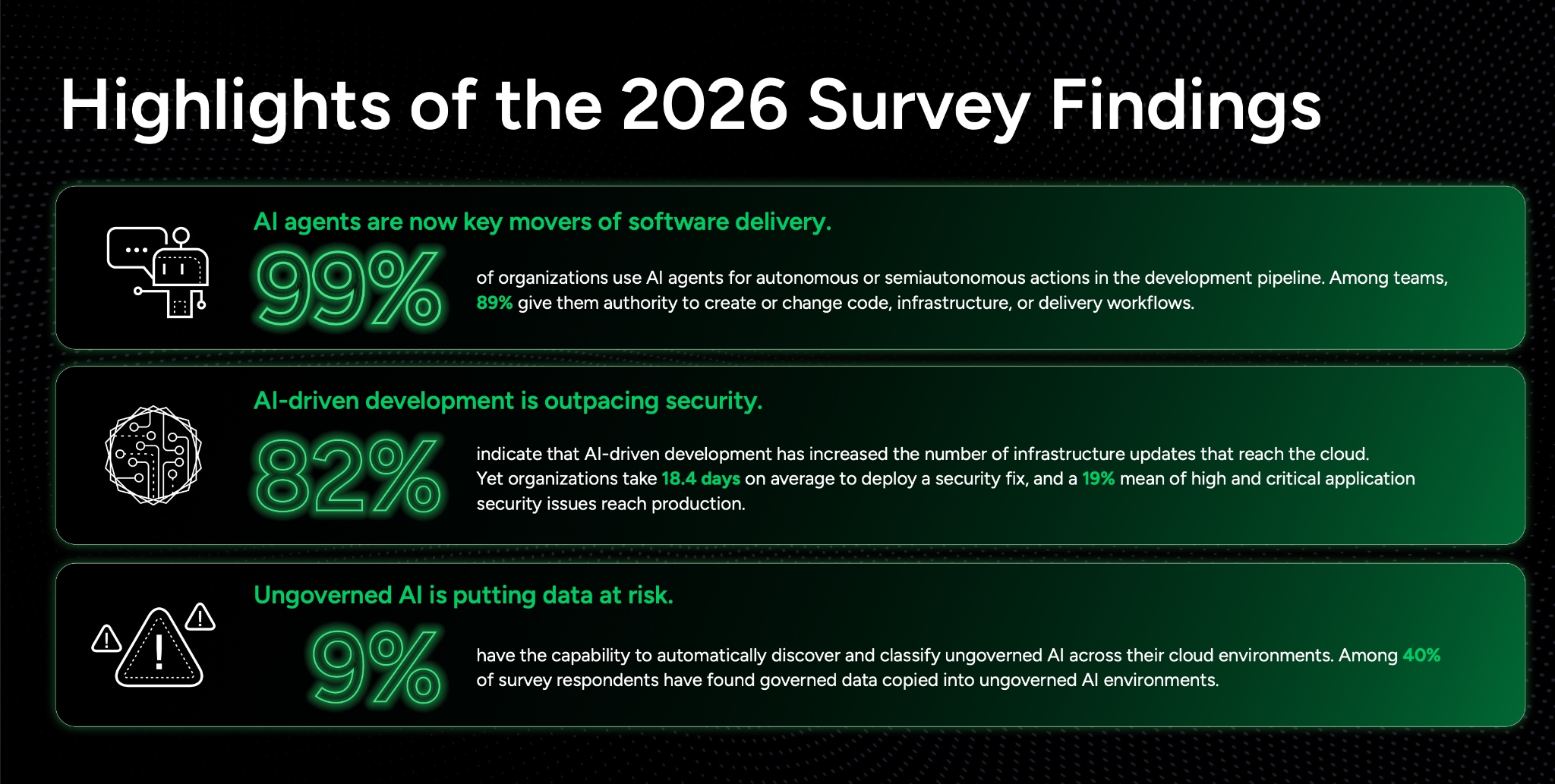
AI agents are becoming an integral part of software development. According to our research, 99% of organizations rely on agents for autonomous or semiautonomous actions in their development pipelines, while 82% report faster cloud infrastructure update cycles.
Agents are also gaining greater authority over development environments. Nearly three-quarters (73%) of organizations allow AI agents to modify code, pipeline configurations, or production environments.
Yet security verification is struggling to keep pace.
On average, organizations enforce fewer than three of the eight pre-deployment security checks evaluated in our research. As a result, respondents report that 19% of high-and critical-severity security issues reach production during a typical release cycle.
The challenge extends beyond security tools. Business pressure to accelerate releases (39%) and unclear risk acceptance policies (30%) remain significant barriers to preventing security issues from reaching production.
As AI agents generate and deploy more code, organizations need to extend security further into development workflows. Preventing vulnerabilities, exposed secrets, and misconfigurations before deployment is increasingly critical to accelerating secure development without introducing unnecessary risk.
2. Autonomous AI Is Creating a New Identity and Visibility Challenge
As AI agents take on more responsibility, security teams face a fundamental question: Who, or what, is making changes across their environments?
Our research found that 40% of organizations cannot fully reconstruct an AI agent's actions after execution. Even more concerning, 53% log agent activity under human developer identities or personal access tokens.
Without distinct identities and clear audit trails, security teams struggle to determine which actions were performed by humans versus AI agents. When a security incident occurs, limited visibility can delay investigation and containment.
Managing agent access introduces additional challenges. Organizations take an average of 2.5 days to revoke or rotate compromised credentials, and 60% still rely on manual processes.
AI adoption is also expanding the data security challenge.
Only 9% of organizations can automatically discover and classify ungoverned AI across their cloud environments. Meanwhile, 40% have identified sensitive, governed data being copied into ungoverned AI tools, and 39% have discovered regulated data being used for unauthorized model training or fine tuning.
As autonomous agents interact with applications, identities, and sensitive data, organizations need unified visibility and governance that extends beyond traditional cloud infrastructure.
3. Frontier AI Is Exposing the Limits of Manual Security Response
AI isn't just accelerating software development. Advances in frontier AI are also increasing the potential speed and sophistication of cyberattacks, including autonomous vulnerability discovery and exploitation.
Our research found that 65% of security leaders consider frontier AI-powered autonomous vulnerability discovery and exploitation a severe threat to critical infrastructure over the next 12 to 18 months. Yet while attacks grow faster and more sophisticated, security teams remain constrained by manual processes.
Organizations take an average of 18.4 days to move a code fix from detection to production. Meanwhile, 47% of teams manually correlate application vulnerabilities with runtime threats, while another 28% don't correlate them at all.
The delays are driven by familiar challenges: manual correlation (34%), waiting for developer action (33%), and difficulty identifying code ownership (31%).
Only 19% of organizations have a unified view connecting code, cloud, identity, and runtime environments.
The growing gap between attack speed and response time highlights the need for a different approach to cloud defense. Security teams need the ability to continuously identify and reduce risk, connect application and cloud context with active threats, and respond in real time.
Four Priorities for Securing the Agentic Cloud
As AI agents become more autonomous and frontier AI advances, organizations need to rethink how they secure both development and cloud environments.
Our findings point to four priorities for security leaders:
- Prevent risk before production. Embed security directly into development workflows and enforce pre-deployment controls across code, dependencies, credentials, and infrastructure configurations. Establish clear risk acceptance policies so development teams can move quickly without introducing unnecessary exposure.
- Strengthen AI agent identity and governance. Assign distinct identities to autonomous agents, enforce least-privilege access, and maintain visibility into agent activity. Implement short-lived credentials and automated revocation to reduce the impact of compromised identities.
- Unify security context from code to cloud to SOC. Connect application security, cloud posture, identity, and runtime security to provide a more complete view of risk and active threats. Extend security context into the SOC to accelerate detection, investigation, and response.
- Automate remediation and response. Reduce reliance on manual workflows by automating risk prioritization, remediation, and response actions. Apply clear guardrails, scoped permissions, and rollback capabilities to enable faster action without sacrificing control.
Cloud Security Must Evolve to Keep Pace With AI
AI agents are fundamentally changing how software is developed, deployed, and managed. Frontier AI is also changing how quickly adversaries can discover and exploit weaknesses.
The findings from this year's State of Cloud Security Report reinforce a clear priority: Organizations need to move beyond fragmented, manual security processes toward a unified approach that prevents risk earlier, continuously reduces exposure, and defends against threats in real time.
The full report explores these challenges in greater detail, including regional and industry trends, emerging risks, and practical recommendations for securing increasingly autonomous cloud environments.
Download the 2026 State of Cloud Security Report.