Beyond the SEG: Why Single-Domain Email Defenses Break Down in the Modern SOC
Generative AI has fundamentally rewritten the rules of social engineering. Using Large Language Models (LLMs), adversaries now automate open-source intelligence collection ingesting corporate org charts, executive speaking schedules, and vendor communications to construct hyper-personalized, context-aware attacks at scale. Because these messages carry no malicious binaries, contain zero bad URLs, and feature pristine header profiles, they exploit a fundamental weakness in enterprise architecture: treating email security as a single, isolated domain.
Why Modern SEGs and ICES Vendors Both Fall Short
To defend against these threats, the industry’s initial response was to upgrade perimeter controls. Modern Secure Email Gateways (SEGs) have evolved far beyond basic signatures and regex rules, incorporating machine learning, dynamic sandboxing, and behavioral heuristics. However, SEGs remain constrained by their inline architectural position at the mail boundary. Operating outside the cloud tenant, SEGs lack deep visibility into internal employee-to-employee communications, historical cloud collaboration patterns, and post-delivery account dynamics.
To bridge this gap, organizations turned to Integrated Cloud Email Security (ICES) platforms. Connecting directly to cloud environments like Microsoft 365 via APIs, ICES tools brought significant advancements. By leveraging Natural Language Processing (NLP) and behavioral profiling, ICES solutions analyze email context to spot Business Email Compromise (BEC) and enable post-delivery remediation.
Yet, even as ICES vendors apply sophisticated AI models to incoming mail, they increasingly struggle to keep pace with modern attacker tactics, techniques, and procedures (TTPs). Attackers now train their own AI models to systematically evade ICES detection baselines obfuscating semantic cues, leveraging compromised legitimate partner accounts, and executing multi-channel attacks that split the lure across email, SMS, and collaboration apps.
According to Gartner’s Market Guide for Email Security, while API-integrated ICES tools provide critical behavioral context, evaluating sender intent strictly within the email platform leaves critical gaps. Gartner highlights that as adversaries refine AI tools to bypass mailbox baselines, email telemetry can no longer exist as a standalone silo, it must be integrated into broader detection and response frameworks like Extended Detection and Response (XDR).
Because standalone ICES detection models operate strictly within the email application, they must judge an email's legitimacy using mailbox telemetry alone. When an attacker successfully mimics legitimate business conversation from a trusted partner, an isolated ICES model has no additional data points to disprove it.
The Silo Penalty: Telemetry Blind Spots and Operational Friction
For modern Security Operations Center (SOC) teams, inspecting email telemetry in an isolated domain creates dangerous operational blind spots during an active intrusion. While an ICES solution can analyze the tone or sentiment of an incoming message, it remains completely blind to post-delivery behavior unable to track whether the recipient executed an anomalous PowerShell command on their host two minutes later, detect a concurrent high-risk login via Microsoft Entra ID from an unfamiliar location, or cross-reference out-of-band network connections triggered by a credential-harvesting site.
Consequently, when an account compromise occurs, analysts are forced to waste critical minutes pivoting between disconnected consoles to manually correlate logs across email platforms, Identity Threat Detection and Response (ITDR), Endpoint Detection and Response (EDR), and Network Detection and Response (NDR). This reliance on standalone email security tools floods the SOC queue with isolated, low-fidelity alerts, driving up alert fatigue and inflating Mean Time to Respond (MTTR) while adversaries pivot laterally across the enterprise environment.

The Paradigm Shift: From Mailbox Filtering to Continuous Correlation
To defend against fast-moving, AI-driven campaigns, organizations must shift from isolated mail filtering to continuous, cross-domain threat correlation. Evaluating sender intent in isolation is no longer sufficient; message metadata and contextual signals must be correlated in real time alongside endpoint telemetry, network flows, and identity risk state.
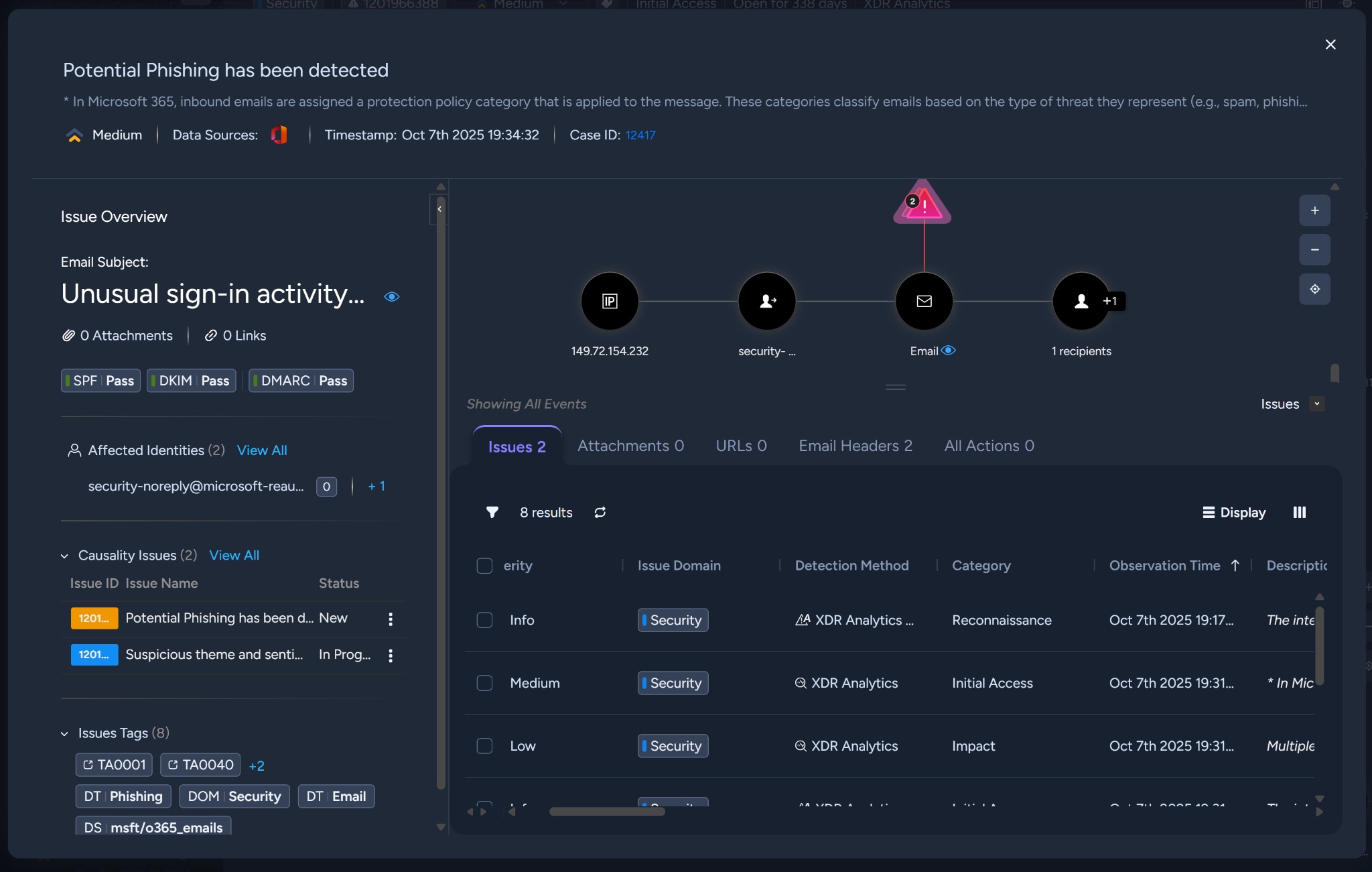
In their analysis of modern email threat dynamics, Gartner explicitly notes that "humans are increasingly incapable of identifying social engineering attacks as LLMs are refined for purpose by attackers." To compensate, analysts recommend that enterprise security leaders shift focus toward architectures that unify email telemetry with broader SOC telemetry—allowing AI engines to analyze cross-domain behavioral signals rather than relying solely on mailbox-level detection.
Unified Threat Correlation: Expanding Beyond Point Solutions
Integrating email telemetry directly into the broader SOC architecture transforms detection and response. Rather than relying on isolated mail filters, intent-based AI detection leverages behavioral analytics and language models directly within the unified SOC data foundation. This multi-signal correlation provides analysts with immediate, end-to-end attack path visualization. For example, if an employee receives an unusual financial authorization request, the SOC platform automatically correlates the email context against host process executions and identity authentication spikes to confirm whether an account takeover has occurred.
Crucially, unifying this data enables automated, cross-domain containment workflows. Once a threat is validated, automated playbooks can execute coordinated response actions simultaneously across the entire enterprise stack quarantining the email message, revoking active user sessions, terminating malicious host processes, and isolating the affected endpoint via EDR.
Treating email security as a standalone layer whether through a gateway or an isolated ICES vendor leaves critical gaps in enterprise defense. Resilience against modern, AI-assisted cyberthreats requires embedding email signals directly into the core detection and response pipeline. By unifying email telemetry with identity, endpoint, and network data through Cortex Advanced Email Security, security teams gain the full-stack visibility and automated control needed to stop multi-stage attacks before they escalate into major incidents.
To explore how Advanced Email Security unifies email telemetry with Cortex XDR to stop phishing and streamline triage, visit our solution page here.
Generative AI has fundamentally rewritten the rules of social engineering. Using Large Language Models (LLMs), adversaries now automate open-source intelligence collection ingesting corporate org charts, executive speaking schedules, and vendor communications to construct hyper-personalized, context-aware attacks at scale. Because these messages carry no malicious binaries, contain zero bad URLs, and feature pristine header profiles, they exploit a fundamental weakness in enterprise architecture: treating email security as a single, isolated domain.
Why Modern SEGs and ICES Vendors Both Fall Short
To defend against these threats, the industry’s initial response was to upgrade perimeter controls. Modern Secure Email Gateways (SEGs) have evolved far beyond basic signatures and regex rules, incorporating machine learning, dynamic sandboxing, and behavioral heuristics. However, SEGs remain constrained by their inline architectural position at the mail boundary. Operating outside the cloud tenant, SEGs lack deep visibility into internal employee-to-employee communications, historical cloud collaboration patterns, and post-delivery account dynamics.
To bridge this gap, organizations turned to Integrated Cloud Email Security (ICES) platforms. Connecting directly to cloud environments like Microsoft 365 via APIs, ICES tools brought significant advancements. By leveraging Natural Language Processing (NLP) and behavioral profiling, ICES solutions analyze email context to spot Business Email Compromise (BEC) and enable post-delivery remediation.
Yet, even as ICES vendors apply sophisticated AI models to incoming mail, they increasingly struggle to keep pace with modern attacker tactics, techniques, and procedures (TTPs). Attackers now train their own AI models to systematically evade ICES detection baselines obfuscating semantic cues, leveraging compromised legitimate partner accounts, and executing multi-channel attacks that split the lure across email, SMS, and collaboration apps.
According to Gartner’s Market Guide for Email Security, while API-integrated ICES tools provide critical behavioral context, evaluating sender intent strictly within the email platform leaves critical gaps. Gartner highlights that as adversaries refine AI tools to bypass mailbox baselines, email telemetry can no longer exist as a standalone silo, it must be integrated into broader detection and response frameworks like Extended Detection and Response (XDR).
Because standalone ICES detection models operate strictly within the email application, they must judge an email's legitimacy using mailbox telemetry alone. When an attacker successfully mimics legitimate business conversation from a trusted partner, an isolated ICES model has no additional data points to disprove it.
The Silo Penalty: Telemetry Blind Spots and Operational Friction
For modern Security Operations Center (SOC) teams, inspecting email telemetry in an isolated domain creates dangerous operational blind spots during an active intrusion. While an ICES solution can analyze the tone or sentiment of an incoming message, it remains completely blind to post-delivery behavior unable to track whether the recipient executed an anomalous PowerShell command on their host two minutes later, detect a concurrent high-risk login via Microsoft Entra ID from an unfamiliar location, or cross-reference out-of-band network connections triggered by a credential-harvesting site.
Consequently, when an account compromise occurs, analysts are forced to waste critical minutes pivoting between disconnected consoles to manually correlate logs across email platforms, Identity Threat Detection and Response (ITDR), Endpoint Detection and Response (EDR), and Network Detection and Response (NDR). This reliance on standalone email security tools floods the SOC queue with isolated, low-fidelity alerts, driving up alert fatigue and inflating Mean Time to Respond (MTTR) while adversaries pivot laterally across the enterprise environment.
Image 1. Highlighting telemetry gaps between standalone email tools and endpoint/identity consoles
The Paradigm Shift: From Mailbox Filtering to Continuous Correlation
To defend against fast-moving, AI-driven campaigns, organizations must shift from isolated mail filtering to continuous, cross-domain threat correlation. Evaluating sender intent in isolation is no longer sufficient; message metadata and contextual signals must be correlated in real time alongside endpoint telemetry, network flows, and identity risk state.
Image 2. SOC workflow showing unified alert ingestion across email, identity, and endpoint agents
In their analysis of modern email threat dynamics, Gartner explicitly notes that "humans are increasingly incapable of identifying social engineering attacks as LLMs are refined for purpose by attackers." To compensate, analysts recommend that enterprise security leaders shift focus toward architectures that unify email telemetry with broader SOC telemetry—allowing AI engines to analyze cross-domain behavioral signals rather than relying solely on mailbox-level detection.
Unified Threat Correlation: Expanding Beyond Point Solutions
Integrating email telemetry directly into the broader SOC architecture transforms detection and response. Rather than relying on isolated mail filters, intent-based AI detection leverages behavioral analytics and language models directly within the unified SOC data foundation. This multi-signal correlation provides analysts with immediate, end-to-end attack path visualization. For example, if an employee receives an unusual financial authorization request, the SOC platform automatically correlates the email context against host process executions and identity authentication spikes to confirm whether an account takeover has occurred.
Crucially, unifying this data enables automated, cross-domain containment workflows. Once a threat is validated, automated playbooks can execute coordinated response actions simultaneously across the entire enterprise stack quarantining the email message, revoking active user sessions, terminating malicious host processes, and isolating the affected endpoint via EDR.
Treating email security as a standalone layer whether through a gateway or an isolated ICES vendor leaves critical gaps in enterprise defense. Resilience against modern, AI-assisted cyberthreats requires embedding email signals directly into the core detection and response pipeline. By unifying email telemetry with identity, endpoint, and network data through Cortex Advanced Email Security, security teams gain the full-stack visibility and automated control needed to stop multi-stage attacks before they escalate into major incidents.
To explore how Advanced Email Security unifies email telemetry with Cortex XDR to stop phishing and streamline triage, visit our solution page here.