High-growth engineering organizations require observability platforms that scale alongside their infrastructure without imposing unpredictable financial overhead. Cortex XCOR operates on a consumption-based pricing model built to align telemetry expenditures directly with real-time operational usage. This article explains the underlying mechanics of our pricing framework and highlights native platform capabilities designed to help engineering teams manage data volumes and control costs effectively.
Flexible Credits Without Monthly Overage Penalties.
Our consumption-based pricing model operates on a straightforward principle: you pay for what you use, exactly when you use it. At the start of a contract, your organization procures a total pool of Credits based on projected usage over the contract duration. These Credits apply flexibly across Cortex XCOR products without requiring your team to re-engage our commercial sales group whenever you want to try new features. As your systems ingest and process data, you burn down your credit balance throughout the contract term. This mechanism ensures you pay for active consumption rather than locked, unused capacity.
How does data optimization factor into pricing?
Alongside flexible credit drawdowns, Cortex XCOR includes native cost optimization features to actively manage spend. Central to this capabilities suite is the Cortex XCOR Optimization Engine, which assesses incoming metrics, logs, and traces in real time. The Optimization Engine maps incoming telemetry directly to actual system usage and generates actionable Recommendations for shaping incoming data streams.
With this in mind, two levers govern how credits are consumed:
- Data processed: the total telemetry volume evaluated prior to Optimization Engine reduction, with no charge applied for dropped metrics.
- Data persisted: the data retained and stored after the Optimization Engine executes data-shaping rules.
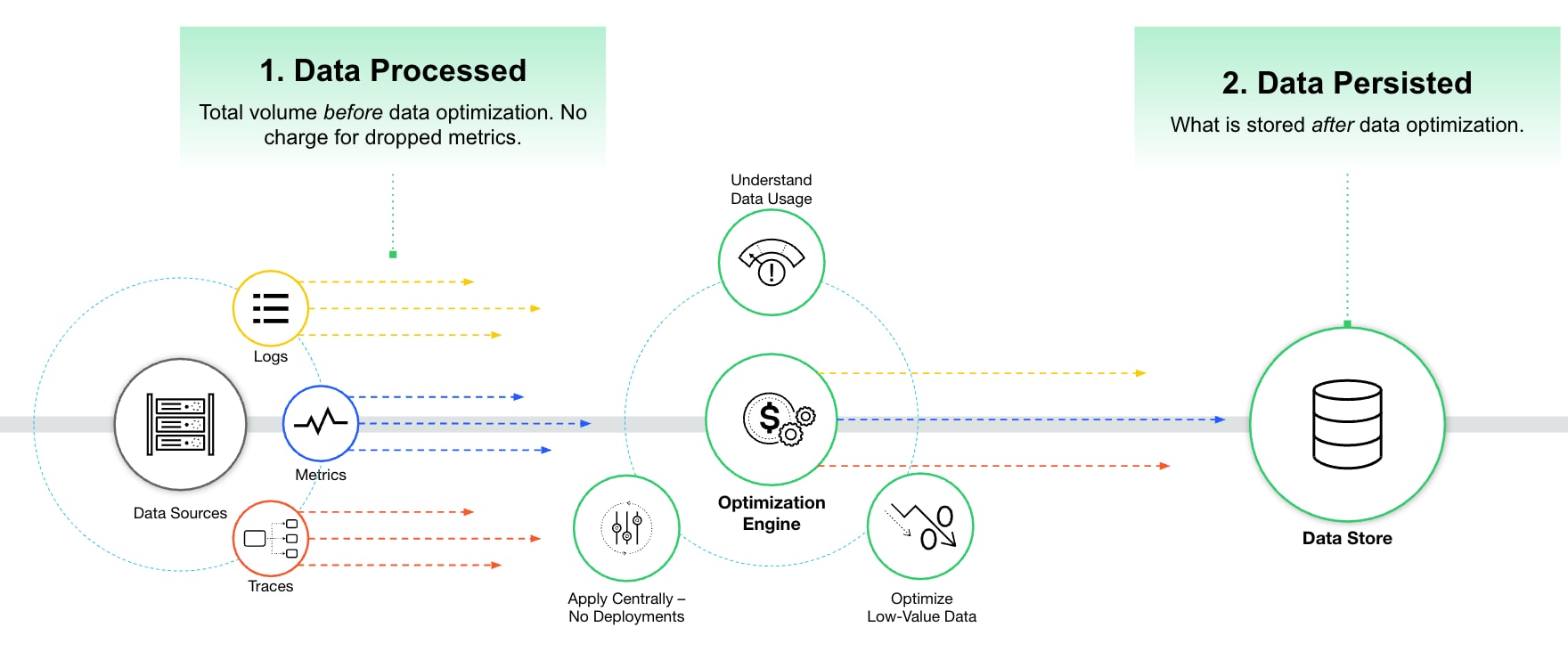
Under this structure, you pay a nominal rate for total processed data while achieving significant savings on stored, persisted data.
Are there monthly overage penalties?
Other vendor pricing models often enforce strict monthly usage caps. When telemetry volume unexpectedly surges in a given month, those models trigger monthly overage charges and surprise penalty fees.
Cortex XCOR eliminates monthly penalties. If an unexpected spike causes your team to exceed projected usage in a given month, there is no financial penalty. You can spend your credit allocation freely across any month within your contract period. Financial penalties do not occur unless you exhaust your entire credit pool before the contract period concludes. To avoid sudden depletion, our team works directly with you well in advance to monitor consumption trends and adjust plans before credits run out.
Consumption Budgets Prevent Unexpected Spend.
To complement our flexible pricing, we are launching the Consumption Budgets feature. In legacy observability setups, a single application team generating a massive data spike can deplete an entire organization's data allocation, driving up costs across every department. Without priority enforcement, noncritical services end up consuming storage capacity required by primary production systems. This leaves platform administrators with difficult manual choices: manually drop telemetry during an active incident or police internal engineering teams after the fact.
Cortex XCOR replaces manual governance with the Consumption Budgets feature. Administrators organize telemetry allocations into distinct partitions based on business units, specific services, environments, or other organizational structures. The system performs real-time consumption analysis across these partitions, tracking ongoing usage trends and flagging emerging spikes before they affect other teams.
Within each partition, administrators set clear budget caps and assign telemetry priorities. When a partition approaches its assigned cap, the platform automatically sheds lower-priority data according to rules preset by the team. Because enforcement acts strictly within the affected partition, overconsumption by one team impacts only that team's low-priority telemetry. This structure preserves broader observability across core systems and prevents unexpected global budget consumption.
Predictable Governance Built for Scaled Engineering Platforms.
Managing observability costs should not require continuous manual policing or unpredictable budget variances. By pairing a flexible, credit-based consumption model with automated data shaping and isolated Consumption Budgets, Cortex XCOR delivers predictable financial control alongside high-signal system monitoring. Engineering teams retain full visibility into critical production services, while platform leaders maintain strict control over every dollar spent.