Maintaining predictable system performance across distributed infrastructure requires identifying issues before they broadly impact your users. While telemetry provides operational visibility, running synthetic tests on endpoint responses from outside the production network exposes regional transit bottlenecks and third-party service regressions early. Since synthetic tests run all the time, they can also let you know when a software update or configuration change impacts system health, rather than finding out after users hit the platform.
Based on requests and feedback from our customers, we are expanding our platform capabilities to include synthetics. Cortex XCOR Synthetics will be in Early Access this winter, with General Availability in 2027. By adding continuous active testing, engineering teams can safeguard SLA commitments, protect revenue against undetected slowness or downtime, and maintain user trust across every software deployment.
Four Targeted Test Layers Across a Global Footprint.
To address core network and application failure modes, Cortex XCOR Synthetics provides targeted test configurations across four core protocol layers:
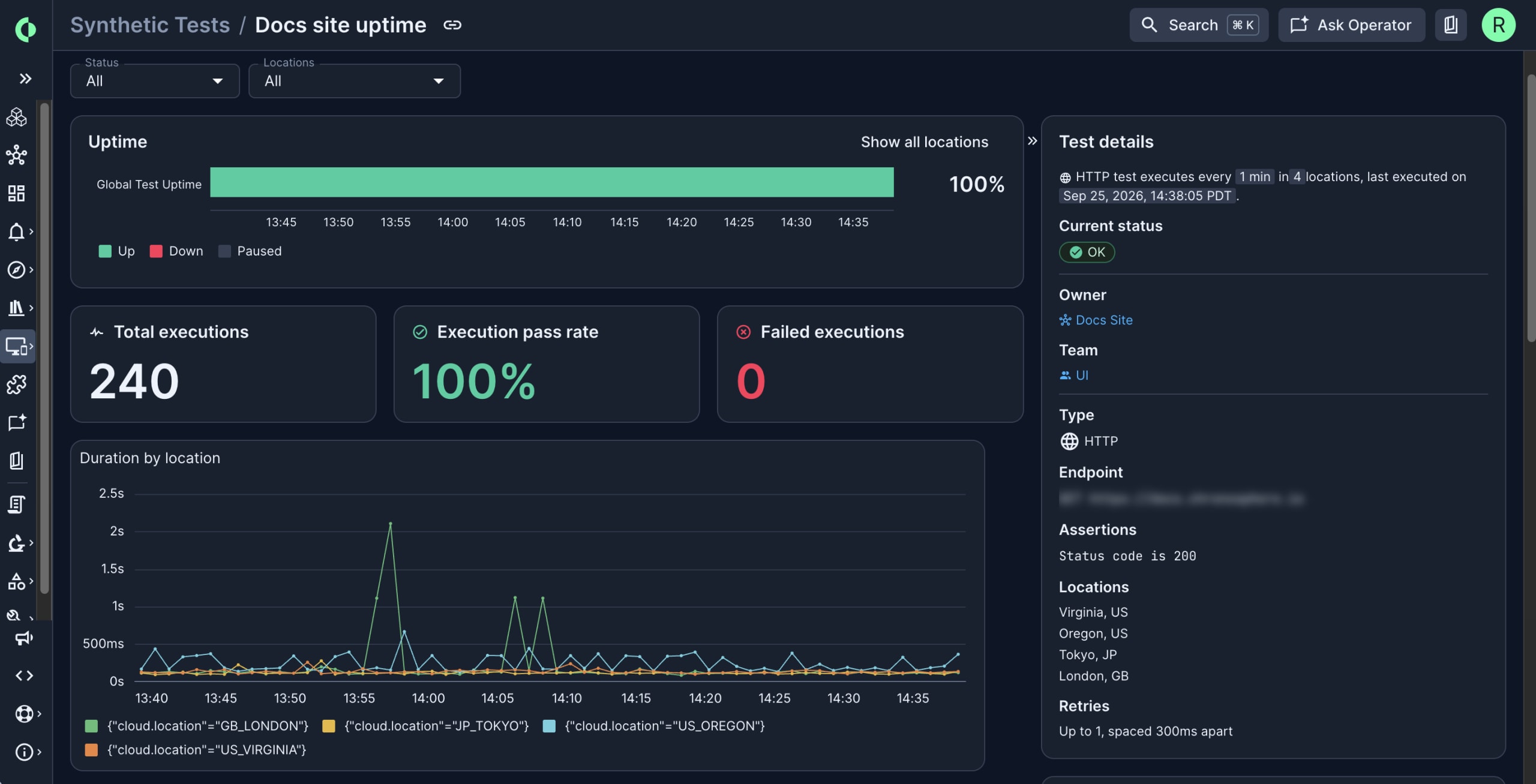
- HTTP: Monitors API endpoint availability, verifies response payload structures, and tracks latency thresholds over time.
- DNS: Validates that public domain names exist and resolve reliably to expected IP addresses.
- TCP: Verifies underlying host reachability and confirms that critical service ports remain open and responsive.
- SSL/TLS: Monitors certificate validity and chain integrity, issuing alerts well before certificates reach expiration.
Teams can execute these synthetic checks across 17 global locations spanning the Americas, APAC, and EMEA regions. Distributing tests across global points of presence helps engineers isolate regional CDN failures, localized routing issues, and geographic latency variances before they degrade performance for end users in those regions. This multi-layer approach eliminates costly blind spots—such as expired SSL certificates or localized DNS failures—giving global operations teams complete confidence that critical services and digital storefronts remain performant in every market.
Detailed Network Timing Breakdowns and Adaptive Alerting Controls.
When an API call slows down, isolating whether the delay stems from the network transport, handshakes, or application code execution determines how the issue gets routed. Cortex XCOR Synthetics provides step-by-step performance timing breakdowns for every executed test. The platform breaks down DNS lookup, TCP connection, TLS handshake, Time to First Byte (TTFB), and Time to Last Byte (TTLB), with a waterfall visualization breaking down the total request duration into individual phases. Phase-by-phase timing breakdowns provide immediate clarity, giving network and application teams shared visibility to pinpoint performance bottlenecks and resolve issues collaboratively.
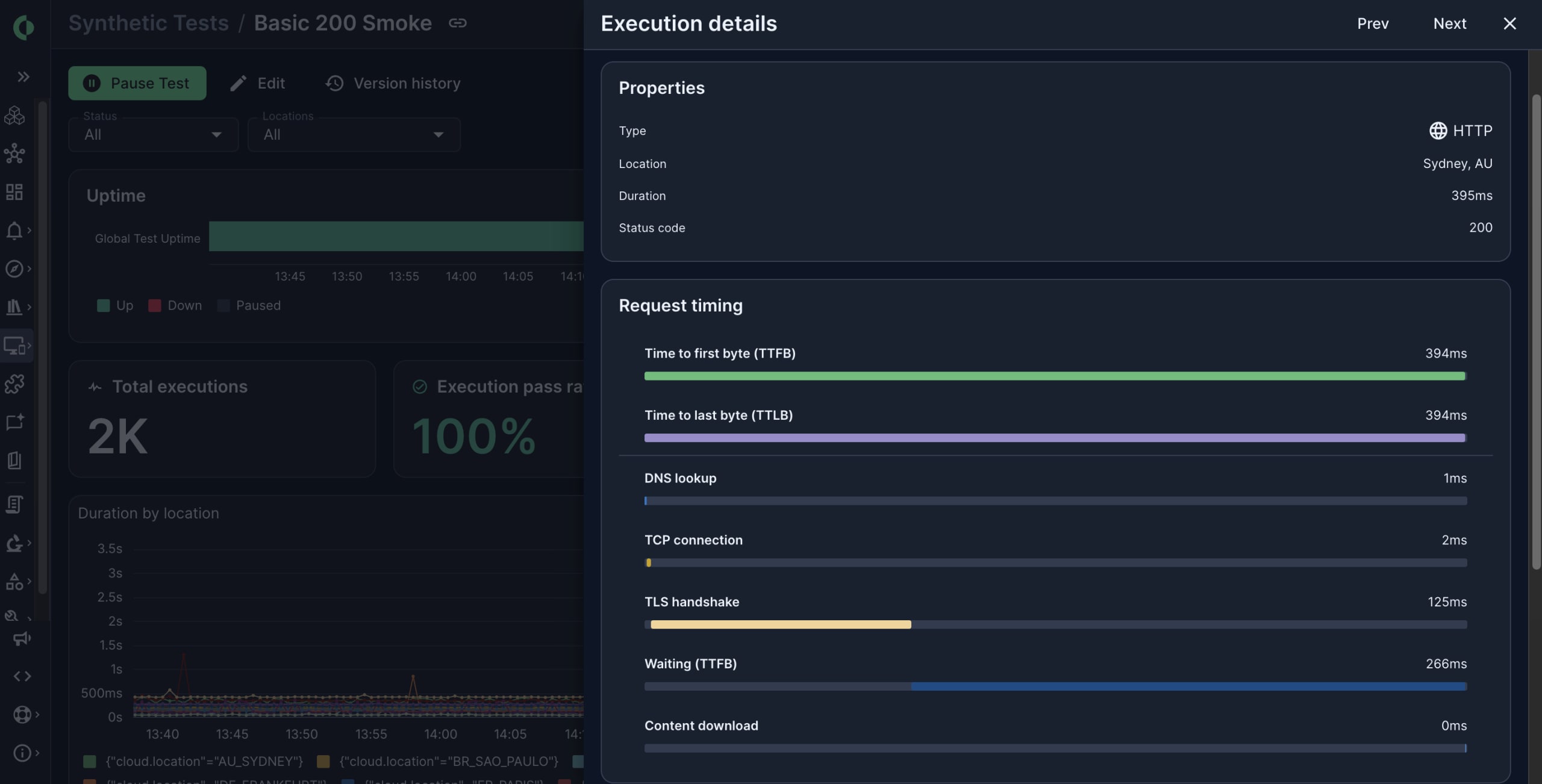
In addition to timing breakdowns, every test execution captures full HTTP response headers, offering deep operational context for diagnosing caching anomalies or header-based routing errors. To validate complex response criteria, teams can configure custom assertions. Tests can validate conditions against HTTP status codes, response times, header values, raw body content, JSON paths, XPaths, and body hashes.
Cortex XCOR Synthetics provides a point-and-click configuration workflow to build tests. You can also use a Terraform provider, APIs, and CLI tooling to define test configurations as code. Config-as-code workflows allow developers to build synthetic checks directly into their existing Git repositories, scaling test coverage without adding configuration management overhead. With these features, teams can construct and execute synthetic tests in minutes.
Open Standards Compatibility Enables Correlation to Backend Traces.
Cortex XCOR is fully compatible with OpenTelemetry (OTel)—from data collection to native platform analytics. Because W3C Trace Context is the standard context propagation format across all OTel SDKs, Cortex XCOR Synthetics leverages these headers to seamlessly stitch synthetic test runs directly to backend trace data.
When a synthetic test fails, you have the ability to pivot directly into the specific backend service, database call, or downstream dependency responsible for the error, eliminating manual correlation across disparate tools.
This seamless bridge between external synthetics and internal backend traces transforms incident response. With access to trace data, responders can pinpoint root causes rapidly, drastically reducing Mean Time to Resolution (MTTR) and keeping developers focused on building features rather than firefighting.
What’s next?
The launch of API and network synthetic monitoring builds the active testing foundation inside Cortex XCOR. Our roadmap expands active monitoring beyond backend API endpoints into the user interface layer. Future platform releases will incorporate front-end synthetic testing, enabling site reliability and platform teams to simulate complex multi-step API workflows and simulate user browser interactions.
Cortex XCOR Synthetics reaches Early Access this winter, with General Availability coming in 2027. If you’re interested in participating in Early Access, talk to your Cortex XCOR account team.