Key Takeaways:
The future of data security isn't about collecting more signals. It's about building a shared context layer. As AI agents, machine identities, and data flows multiply, isolated alerts can no longer keep pace. By continuously layering identity, behavior, data, path, and business context, organizations can move beyond detection to adaptive, autonomous enforcement, giving every analyst, application, and AI agent the same continuously evolving understanding of risk.
Enterprise security is facing a silent tipping point: according to the Palo Alto Networks’ 2026 Identity Security Landscape Report, machine identities now outnumber humans 109 to 1. Worse, 79 of those 109 are AI agents—deciding, moving, and manipulating data at a velocity no human review process can touch. Commercial off-the-shelf agents are already running in production - from Salesforce Agentforce resolving customer cases to Microsoft Copilot drafting responses from internal documents to ServiceNow AI Agents executing IT workflows - reading sensitive data, making API calls, chaining decisions across systems, and acting on outcomes, all with or without a human in the loop.That shift changes far more than the number of identities enterprises need to manage. It also changes the fundamental problem security teams are trying to solve. For the past two decades, security platforms competed by detecting more. More signatures. More alerts. More telemetry. More dashboards. Success was measured by visibility.
Today, visibility is no longer the bottleneck. Decision-making is.
Every modern security stack can tell you that something happened. A file matched a DLP policy. A user logged in from a new location. An AI application received sensitive data. A browser uploaded source code to an unfamiliar destination. The harder question is whether any of those events actually matter. Is this a repeat high-risk user with past risky actions? A contractor working from a temporary location? An autonomous AI agent behaving outside its intended scope? Or simply another false positive buried among thousands of daily alerts? Detection tells you an event occurred. However, it doesn't tell you how much you should care. That distinction becomes critical as enterprises embrace AI.
Context Is Built in Layers
For years, data leaks followed a familiar pattern. An employee emailed the wrong attachment, copied sensitive files to removable media, or uploaded documents to an unauthorized application. Each event was evaluated independently because every alert represented a single moment in time.
The model no longer works. Today, sensitive data moves through AI assistants, browsers, SaaS applications, and autonomous agents. Recent public incidents have shown that data can be exposed through AI prompts, indirect prompt injection, or compromised AI integrations with a massive blast radius in a matter of seconds. The challenge isn't visibility. It's understanding whether an event is routine or the beginning of something much bigger.
Imagine an engineer using an unapproved AI assistant for the first time. One interaction might simply be experimentation or approved work. However, when the same user repeats the behavior days later, and proprietary information continues flowing to the same destination, those are no longer independent alerts. They're one evolving story. Likewise, when numerous team members use the same pathway, security teams can flag the associated application for heightened inspection or a potential block. Providing this critical distinction is the true value of context.
Context isn't collected from a single source. It's built by layering multiple perspectives around every event, each answering a different question. Together, they transform isolated signals into a complete understanding of risk.
- The journey begins with a raw signal. It tells us what happened, whether that's a DLP match, inline inspection, browser event, or API finding, but on its own, it's only a moment in time, not a story.
- Identity and business context add who and why it matters now. Is this a trusted employee or a departing contractor? Is this user on an M&A deal team or under regulatory audit? The same event carries very different risks depending on the identity behind it and the business reality surrounding it.
- Technology and data context add how the data moved and what it actually means. Was this a corporate or personal device? A sanctioned instance or shadow IT? And beyond the classification - is this a routine support exchange, or is someone pasting pre-announcement financials into an unsanctioned AI tool? The sensitivity isn't just the data type. It's the channel, the environment, and the intent surrounding the conversation it's embedded in.
- Path and behavior complete the picture. Path reconstructs the full journey - origin to destination, every hop, across every detector, connecting what would otherwise appear as isolated alerts. Behavior answers whether any of it is normal, comparing against historical baselines to turn accumulated context into confidence that distinguishes routine activity from meaningful risk.
Only when these layers come together can the platform move beyond simply detecting an event to confidently determining the right response, whether that's allowing the activity, stepping up authentication, redacting sensitive data, or blocking it altogether.
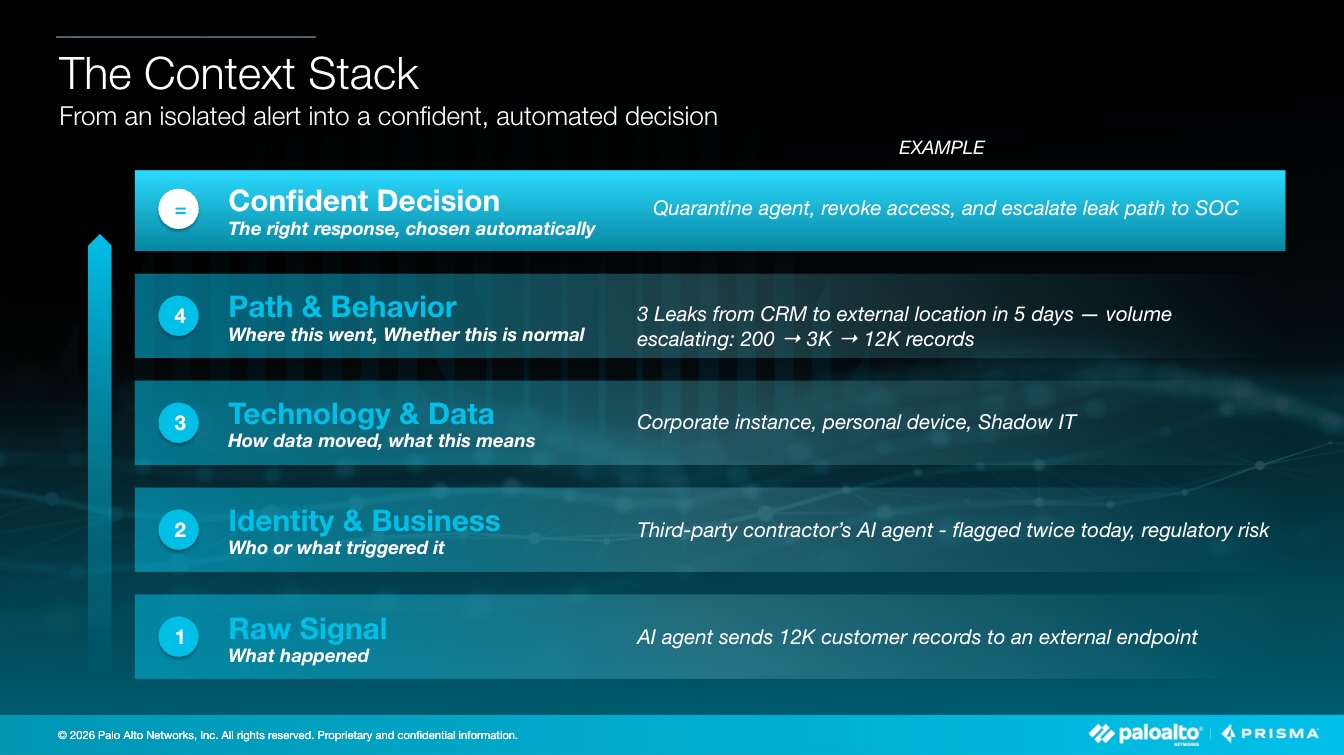
Figure 1. The Context Stack
Context Should Drive the Response, Not Just Describe It
Building context is only half the job. If context simply enriches an alert before handing it to an analyst, security teams are still making the same manual decisions, just with more information.
The real value of context is that it should drive the response.
Most enforcement today is still binary: allow or block. That worked when organizations were primarily governing human users moving at human speed. However, it doesn't work in a world where machine identities outnumber humans 109 to 1, AI agents operate autonomously, and millions of events demand decisions in real time.
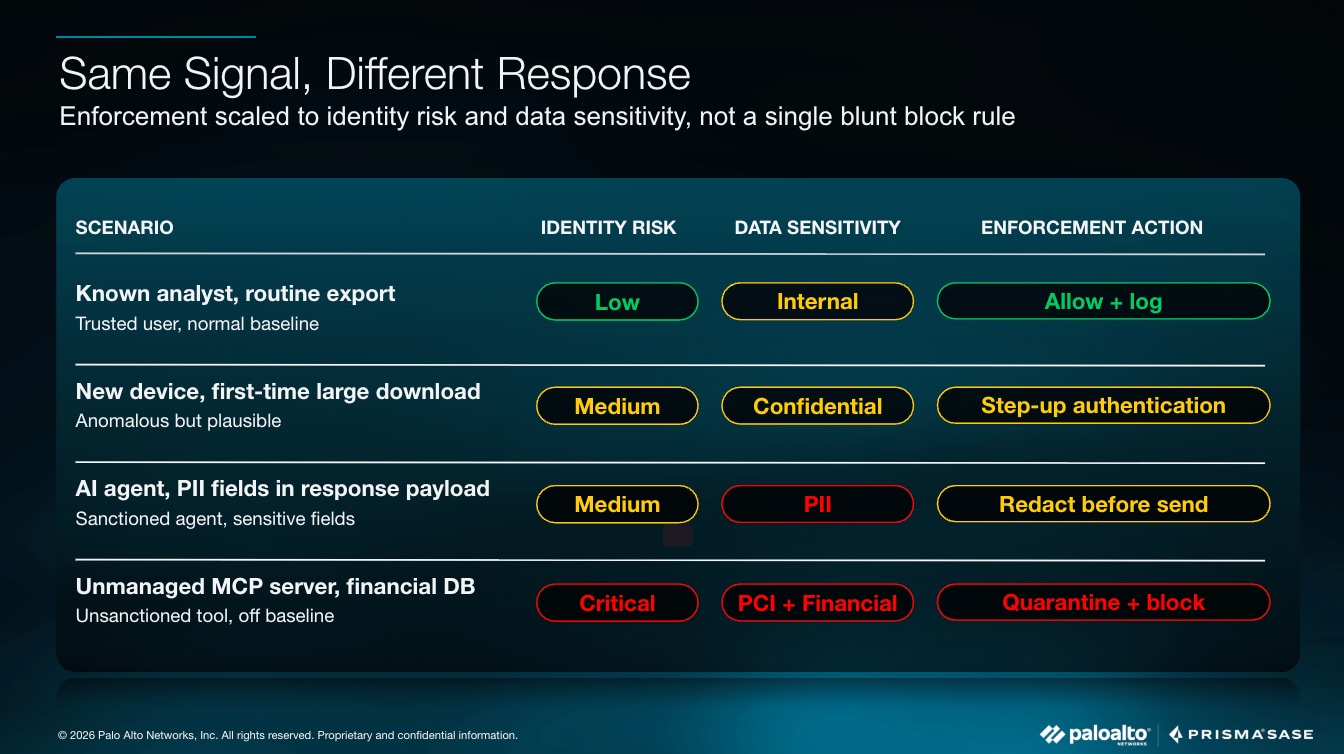
Look at those four scenarios. Every one starts with the same DLP alert. But the outcome? That’s context in action.
- Trusted analyst? Allowed and logged. Zero friction.
- New device, large download? Step-up authentication. We verify intent. Instead of killing productivity, we preserve it.
- AI agent surfacing PII? Redacted in flight. Work continues, risk stops.
- Unmanaged MCP server hitting finance data? Quarantined instantly.
This is context-driven, adaptive enforcement. Stop choosing between "block everything" or "let it run." Score the risk, pick the proportional action, and execute—at machine speed. As a result, manual triage will be history in two years. Not because analysts are gone, but because the 80% of "easy" decisions are handled automatically, freeing your team for the 20% that actually demand human judgment.
Context Only Wins If It Travels
Context shouldn't live in a single dashboard. It should be available wherever security decisions are made.
Here's a prediction: within the next 24 months, “ Can your security context be consumed as a service?” will become as fundamental a procurement question as “Do you have an API?" was a decade ago. Context shouldn't be something analysts read after an alert. Instead, it should be something every application, workflow, and AI agent can query before taking action.
Security operations platforms use it to prioritize investigations. Identity systems continuously enrich it with joiner, mover, and leaver signals. Business applications apply the same understanding of user and data risk without rebuilding security logic. Meanwhile, AI agents will use that same context to determine whether an action should proceed before it's ever executed.
Correlate signals once. Build context once. Score risk once. Then make that understanding available everywhere. Human analysts, security tools, business applications, and AI agents should all operate from the same shared understanding of risk, instead of rebuilding their own partial picture of every event.
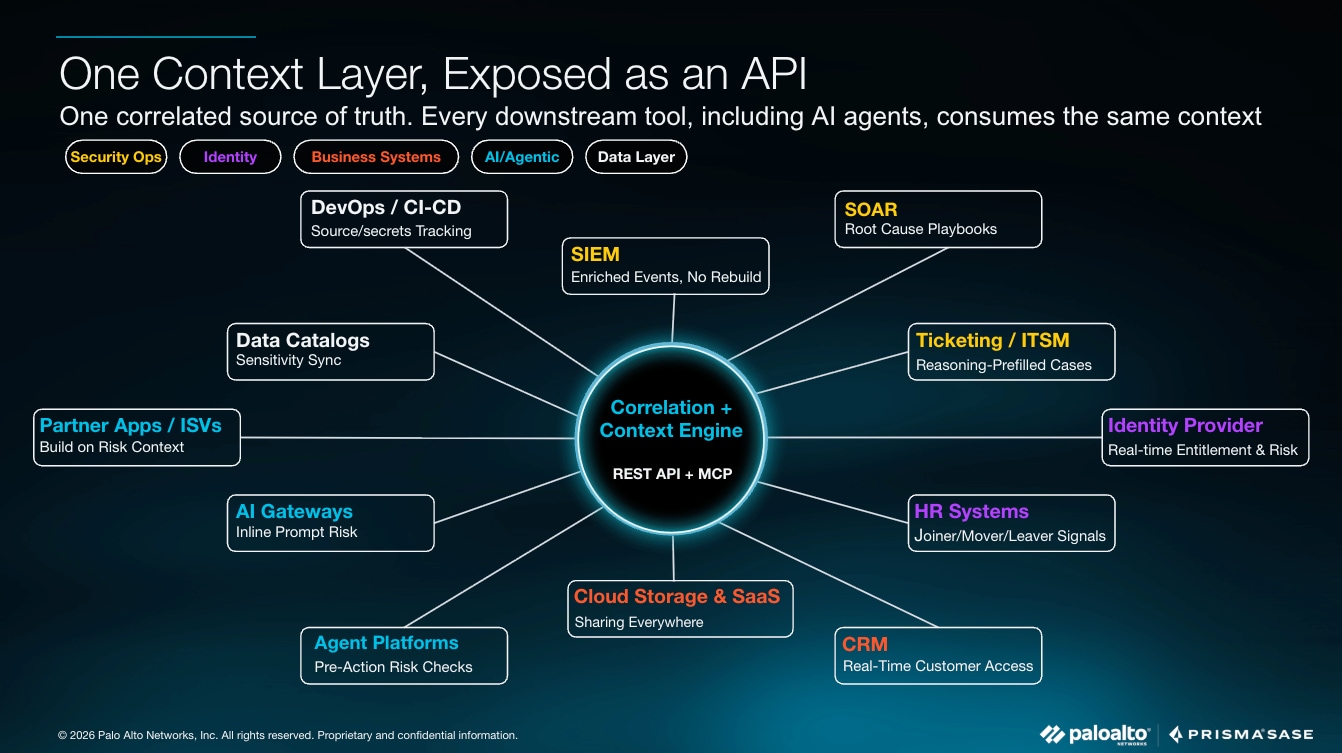
Figure 3. One Shared Context Layer As The Enterprise Intelligence Layer
Where Context Becomes Action
The next generation of security won't be defined by who collects the most signals. It will be defined by who can turn shared context into decisions, instantly, consistently, and at machine speed.
Natural Language Querying via MCP
Natural language becomes the new security interface. By leveraging the Model Context Protocol (MCP), analysts no longer need to learn query languages or pivot across multiple consoles. Instead, they simply ask: "Show me every sensitive data event involving this user across all DLP scans over the last 30 days." The platform doesn't return disconnected alerts. It reconstructs the complete leak path, behavioral history, identity context, and current risk score, delivering an answer instead of data. Context becomes something you can query, not something you have to manually assemble.
Context-Aware Agents
The same shared context enables autonomous agents to move beyond rule execution to intelligent decision-making. Administrators express intent in natural language, such as "Block source code uploads to personal AI applications." The agent translates that intent into policy, validates it against historical activity, highlights potential impact and false positives, and presents the proposed changes for approval before enforcing the policy consistently across every enforcement point.
Once deployed, those same agents continue operating autonomously. Instead of treating every event equally, they can evaluate identity, behavior, destination, and historical context to determine the appropriate response, allowing trusted activity, stepping up authentication, redacting sensitive data in flight, or quarantining compromised devices in real time.
This shifts security from manual investigation to intelligent execution. Analysts focus on the exceptions that require judgment, while context-aware agents continuously handle the routine decisions at machine speed.
Building the Context Layer, One Phase at a Time
A context layer isn't built overnight. It grows stronger as more signals, richer context, and broader enforcement come together. That's why we're delivering it in phases, with each step building on the last rather than starting over.
First, our UEBA MVP anchors on SaaS API and DLP telemetry - our most mature signals - to instantly build behavioral baselines for every identity. Next, SaaS Inline and CIE take that intelligence to stop risky actions in real time via identity, extending context from data at rest into real-time, in-line traffic, so the behavioral model sees data the moment it moves, not after the fact, enforcing actions before they ever hit the log.
Prisma Browser detector comes next, pulling browser-level activity - uploads, downloads, copy/paste, session context - into the same identity risk baseline the MVP already established. From there, context widens deliberately, one detector at a time, without ever throwing out or duplicating what came before.
Finally, Data Leak Path gets fully wired to complete the journey, giving every one of those baselines the full path layer - origin to exposure, across every detector at once - instead of a single-hop view.
Every phase makes the context layer smarter. Every new signal sharpens confidence. Every additional layer enables more precise decisions.
This is our meaningful start. We're moving from reactive defense to autonomous protection, where context doesn't just monitor activity; it continuously learns, reasons, and drives action across the enterprise.
The security teams that win the next three years won't be the ones with the most detections. They'll be the ones that transform shared context into every security decision, replacing static rules and manual triage with intelligent, proportional enforcement at machine speed.
The future of security won't be defined by another sensor, another dashboard, or another AI model. It will be defined by a shared context layer that powers every analyst, every application, and every AI agent with the same continuously evolving understanding of risk.
Talk to a data security expert today to learn how we're building that future and how your organization can move beyond detection toward autonomous, context-driven protection.